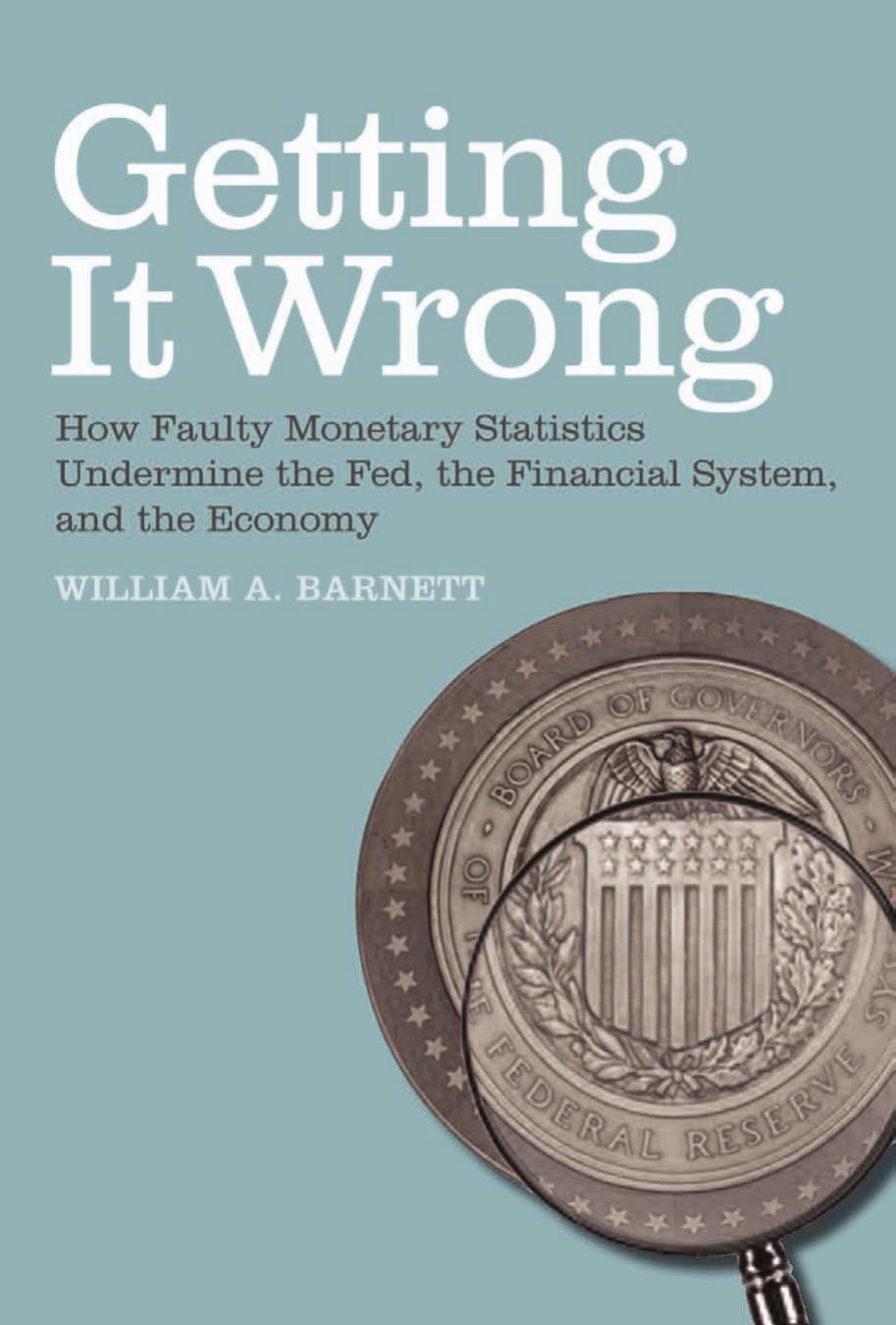
Getting It Wrong: How Faulty Monetary Statistics Undermine the Fed, the Financial System, and the Economy by William A. Barnett
Author:William A. Barnett [Barnett, William A.]
Language: eng
Format: epub, pdf
Tags: Business & Economics, Econometrics, Finance, General
ISBN: 9780262516884
Google: MXQFfAEACAAJ
Publisher: MIT Press
Published: 2012-07-15T00:31:42.113015+00:00
5 Summary and Conclusion
It is well to recall the warning of Josiah Stamp, once both director of the Bank of England and president of the Royal Statistical Society. The statistics governments relied on were, he observed, ultimately derived from the records of the village night watchman, âwho just put down whatever he damn pleased.â
â(John Kay, The Financial Times, April 5, 2011.)
Most of the puzzles and paradoxes that have evolved in the monetary economics literature, since the early 1970s, were produced by the simple-sum monetary aggregates, which are provided officially by many central banks, including the Federal Reserve. Those puzzles and paradoxes are resolved by use of proper aggregation-theoretic monetary aggregates. Except for the Bank of Englandâs data, the National Bank of Polandâs data, and Bank of Israel data, official central bank data provided to the public throughout the world have not significantly improved. Nevertheless, better data do exist, available only internally within some of those central banks, such as the Divisia monetary aggregates produced by the European Central Bank for the use of its Governing Council and the Bank of Japan Divisia data provided only to its executives. Some central banks make the better data available publicly, but only unofficially, such as the Divisia (MSI) money supply data provided by the St. Louis Federal Reserve Bank, but not included by the Federal Reserve Board in its official releases. As mentioned in section 2.6 of chapter 2, official or unofficial Divisia monetary aggregates data are available for over 37 countries, and that number of countries is increasing rapidly, as can be seen on the website of the Center for Financial Stability in New York City.
Researchers should be cautious about the use of official central bank data in research. This book documents the fact that the economics profession, financial firms, borrowers, lenders, and the central banks themselves have repeatedly been misled by poor central bank monetary data over the past half century. A primary objective of this book is to show that poor Fed data unnecessarily complicated private decision-making and interfered with the abilities of the private sector to recognize the extent of the systemic risk existing during the years leading up to the financial crisis and the Great Recession. A secondary objective is to provide evidence that the Fed itself has made repeated policy errors, best explained by use of its own poor data.
If you are looking for simple answers to difficult questions or support for a particular political ideology, you bought the wrong book. I wrote this book for those who want to deepen their understanding of what has happened, including how it evolved over thirty years, and why it happened. But here is one clear statement. The Federal Reserve Board has âgotten it wrong.â In contrast, there is at least one major central bank that has âgotten it rightâ: the Bank of England. This fact has been recognized by the IMF, in the most recent edition of its Monetary and Financial Statistics: Compilation Guide.1 Remember what Paul Revere said
Download
Getting It Wrong: How Faulty Monetary Statistics Undermine the Fed, the Financial System, and the Economy by William A. Barnett.pdf
This site does not store any files on its server. We only index and link to content provided by other sites. Please contact the content providers to delete copyright contents if any and email us, we'll remove relevant links or contents immediately.
The Brazilian Economy since the Great Financial Crisis of 20072008 by Philip Arestis Carolina Troncoso Baltar & Daniela Magalhães Prates(360865)
International Integration of the Brazilian Economy by Elias C. Grivoyannis(111585)
The Art of Coaching by Elena Aguilar(53640)
Flexible Working by Dale Gemma;(23358)
How to Stop Living Paycheck to Paycheck by Avery Breyer(19834)
Thinking, Fast and Slow by Kahneman Daniel(12526)
The Acquirer's Multiple: How the Billionaire Contrarians of Deep Value Beat the Market by Tobias Carlisle(12428)
The Radium Girls by Kate Moore(12177)
The Art of Thinking Clearly by Rolf Dobelli(10713)
Hit Refresh by Satya Nadella(9253)
The Compound Effect by Darren Hardy(9146)
Tools of Titans by Timothy Ferriss(8591)
Atomic Habits: Tiny Changes, Remarkable Results by James Clear(8515)
Turbulence by E. J. Noyes(8200)
A Court of Wings and Ruin by Sarah J. Maas(8107)
Change Your Questions, Change Your Life by Marilee Adams(7929)
Nudge - Improving Decisions about Health, Wealth, and Happiness by Thaler Sunstein(7850)
How to Be a Bawse: A Guide to Conquering Life by Lilly Singh(7613)
Win Bigly by Scott Adams(7343)
